Beauty Through Art
Art historian Katy Hessel traces how art has shaped, and been shaped by, our ideas of beauty across time.


The 1930s saw the rise of the hard-edged, metallic Art Deco. With this came new beauty trends for women, as captured by the Polish-born artist, Tamara de Lempicka, who was famed for her stylised portraits that captured the spirit of the new age.
She once said, “My goal is never to copy. Create a new style, clear, luminous colours, and feel the elegance of the models.”
Capturing her feminine, but powerful, women in their short hair, trousers and bold makeup, she connected the beauty trends of the 1920s to growing female emancipation.
The strikingly dark eyes and red lip, as seen in de Lempicka’s The Blue Scarf (right), played on the popular look, set by Joan Crawford and Greta Garbo. Her paintings also echo the Hollywood studios’ love of a tightly cropped image, to indulge the woman’s sultry but commanding expression.
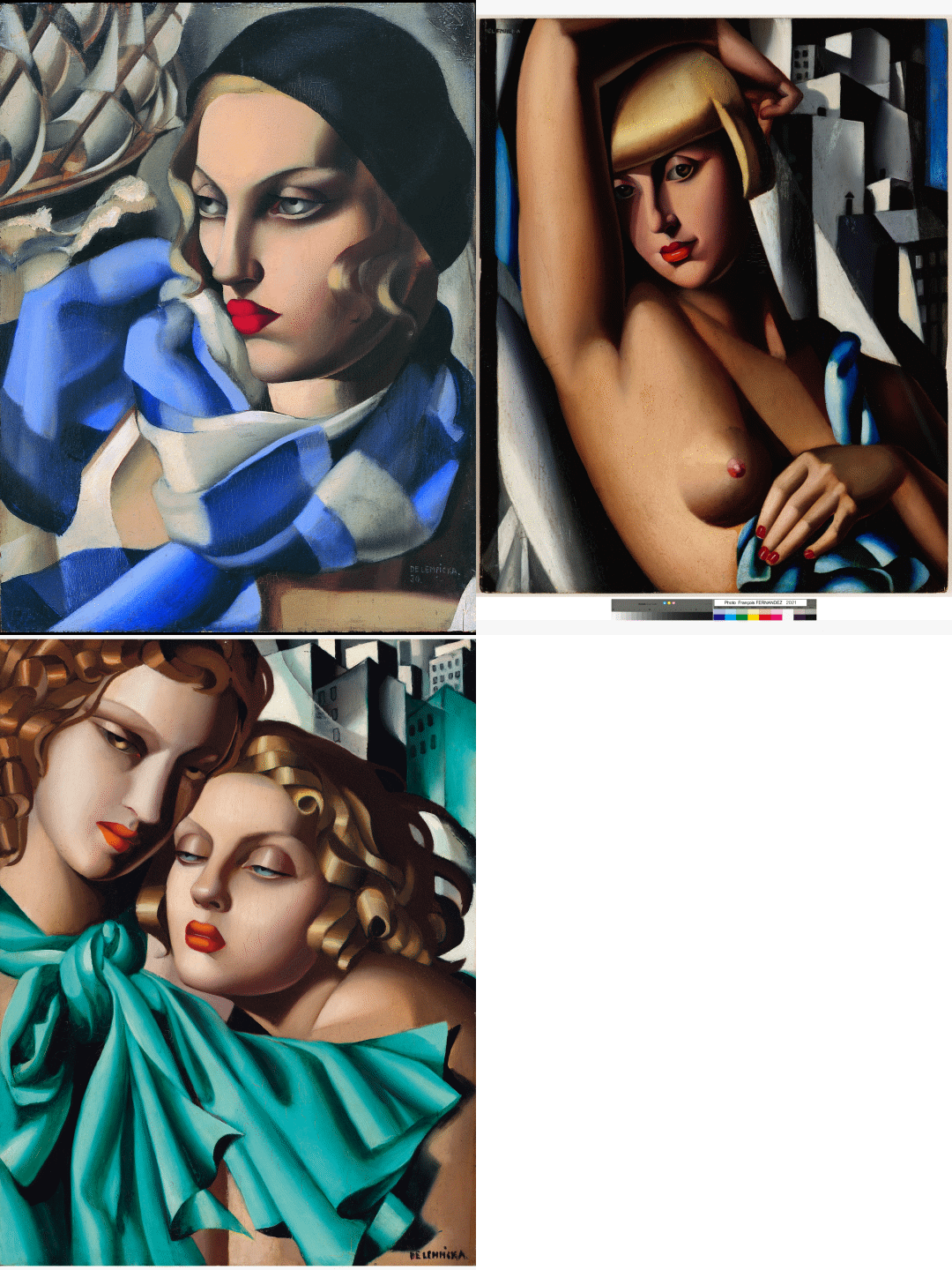
1: Tamara de Lempicka, The Blue Scarf (1929). 2: Tamara de Lempicka, Portrait of Suzy Solidor (1933). 3: Tamara de Lempicka, The Girls (1930). Image credits: All © Tamara de Lempicka Estate, LLC/ ADAGP, Paris.
The 1930s saw the rise of the hard-edged, metallic Art Deco. With this came new beauty trends for women, as captured by the Polish-born artist, Tamara de Lempicka, who was famed for her stylised portraits that captured the spirit of the new age.
She once said, “My goal is never to copy. Create a new style, clear, luminous colours, and feel the elegance of the models.”
Capturing her feminine, but powerful, women in their short hair, trousers and bold makeup, she connected the beauty trends of the 1920s to growing female emancipation.
The strikingly dark eyes and red lip, as seen in de Lempicka’s The Blue Scarf (right), played on the popular look, set by Joan Crawford and Greta Garbo. Her paintings also echo the Hollywood studios’ love of a tightly cropped image, to indulge the woman’s sultry but commanding expression.
1: Tamara de Lempicka, The Blue Scarf (1929). 2: Tamara de Lempicka, Portrait of Suzy Solidor (1933). 3: Tamara de Lempicka, The Girls (1930). Image credits: All © Tamara de Lempicka Estate, LLC/ ADAGP, Paris.

Tamara de Lempicka, Autoportrait (Tamara in a Green Bugatti) (1929). Image credit: © Tamara de Lempicka Estate, LLC/ ADAGP, Paris
But, as a working and successful artist, she was also keen on epitomising the beauty trends herself.
This is her self-portrait (left), fittingly holding firmly the wheel of a green Bugatti car, cloaked in a marble-like cloche hat and matching scarf that appears to be blowing in the wind. She sports dark, smoky eyes, a golden bob and a flash of red for her lips.
The painting was commissioned by Die Dame, a German fashion magazine, for its cover celebrating the independence of women.
Tamara de Lempicka, Autoportrait (Tamara in a Green Bugatti) (1929). Image credit: © Tamara de Lempicka Estate, LLC/ ADAGP, Paris
But, as a working and successful artist, she was also keen on epitomising the beauty trends herself.
This is her self-portrait (left), fittingly holding firmly the wheel of a green Bugatti car, cloaked in a marble-like cloche hat and matching scarf that appears to be blowing in the wind. She sports dark, smoky eyes, a golden bob and a flash of red for her lips.
The painting was commissioned by Die Dame, a German fashion magazine, for its cover celebrating the independence of women.
For de Lempicka, beauty was tied up in everything. As her great-granddaughter, Marisa de Lempicka, told me: “For Tamara, everything had to be beautiful! Art had to be beautiful, attractive. She was creating something new, very different from the Impressionists, where she said they used ‘dirty colours’...
“She herself also had to be beautiful – the way she presented herself to the world was essential. Clothing, jewellery and makeup were not superficial matters; they were part of her identity. She was ‘made up’ until the day she died.”
She has since attracted fans such as Barbra Streisand and Madonna, who have adopted traits of de Lempicka’s continuously enduring beauty look.
Madame D’Ora (Dora Kallmus), Tamara in a Marcel Rochas dress (c. 1928). Image credit: Dora Kallmus © Tamara de Lempicka Estate, LLC/ ADAGP, Paris
For de Lempicka, beauty was tied up in everything. As her great-granddaughter, Marisa de Lempicka, told me: “For Tamara, everything had to be beautiful! Art had to be beautiful, attractive. She was creating something new, very different from the Impressionists, where she said they used ‘dirty colours’...
“She herself also had to be beautiful – the way she presented herself to the world was essential. Clothing, jewellery and makeup were not superficial matters; they were part of her identity. She was ‘made up’ until the day she died.”
She has since attracted fans such as Barbra Streisand and Madonna, who have adopted traits of de Lempicka’s continuously enduring beauty look.
Madame D’Ora (Dora Kallmus), Tamara in a Marcel Rochas dress (c. 1928). Image credit: Dora Kallmus © Tamara de Lempicka Estate, LLC/ ADAGP, Paris
With the invention of the camera in the late 19th century, advertisements –including for beauty products – shifted from illustration to photography.
At the forefront of this, in Paris, was Dora Maar, who was known for her surrealist eye when it came to both her commercial and artistic work. Using photographic techniques such as photomontage (combining two or more images) or playing with light and shadow, Maar conjured up pioneering ways of working.
These included Femme aux cheveux avec savon (‘Woman’s hair with soap’); a shampoo promotion depicting a highly imaginative image of a woman washing her sculpture-like hair. It seems worlds away from the sleek bobs of de Lempicka’s paintings. Is she showing the reality of what it takes to get there?
Dora Maar, The Years Lie in Wait for You (1935), The William Talbott Hillman Collection. Image credit: © Dora Maar, ADAGP/Copyright Agency, 2026
Maar’s imaginative images also spoke to the ever-enduring obsession of maintaining a youthful complexion, as seen in her photomontage The Years Lie in Wait for You (left).
It’s of her friend, the poet Nusch Éluard, with a spider’s web superimposed over her face, created as marketing for an anti-ageing cream.
One way I read this is the woman, with seemingly unblemished porcelain skin, is looking out on an aged, ‘imperfect’ web – as if it is a reminder of the inevitability of what is to come.
The spider, forever trapped in the middle of its web, could be a metaphor for the trappings of being a woman – the constant expectation of appearing forever youthful – and not being able to get out.
Dora Maar, The Years Lie in Wait for You (1935), The William Talbott Hillman Collection. Image credit: © Dora Maar, ADAGP/Copyright Agency, 2026
Maar’s imaginative images also spoke to the ever-enduring obsession of maintaining a youthful complexion, as seen in her photomontage The Years Lie in Wait for You (left).
It’s of her friend, the poet Nusch Éluard, with a spider’s web superimposed over her face, created as marketing for an anti-ageing cream.
One way I read this is the woman, with seemingly unblemished porcelain skin, is looking out on an aged, ‘imperfect’ web – as if it is a reminder of the inevitability of what is to come.
The spider, forever trapped in the middle of its web, could be a metaphor for the trappings of being a woman – the constant expectation of appearing forever youthful – and not being able to get out.
One of the most recognisable faces in art history is that of the Mexican-born artist, Frida Kahlo.
Immortalised in approximately 55 self-portraits, Kahlo painted herself with animals, as a wounded deer, in love and full of happiness with her husband Diego Rivera, as well as heartbroken and lonely. Part of the reason why she painted herself so often was because – as she said – “I am the subject I know best.”
She suffered from polio as a child, which left her with one leg shorter than the other. Then, aged 18, she was severely injured in a bus accident and confined to her bedroom while she recovered. Given paints by her mother, who installed a mirror above her bed, Kahlo initially decorated the plaster casts that held her back in place before venturing into self-portraits.
Kahlo understood the power of taking something symbolic of pain and turning it into something beautiful.
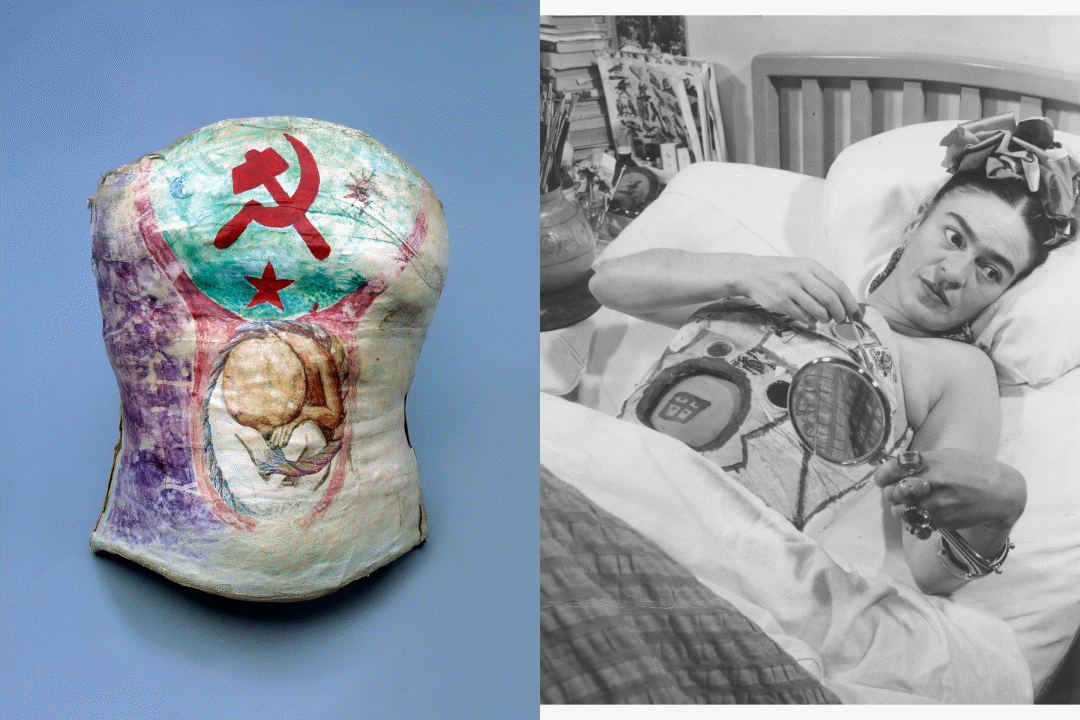
1: Frida Kahlo, Plaster Corset (1950). Photo: Schalkwijk / Art Resource, NY © 2026 Banco de México Diego Rivera Frida Kahlo Museums Trust, Mexico, CDMX / Artists Rights Society (ARS), New York/Copyright Agency, 2026. 2:Juan Guzmán, Frida Kahlo painting a plaster corset (1944), Throckmorton Fine Art. Image credit: © Juan Guzmán, courtesy of Throckmorton Fine Art
One of the most recognisable faces in art history is that of the Mexican-born artist, Frida Kahlo.
Immortalised in approximately 55 self-portraits, Kahlo painted herself with animals, as a wounded deer, in love and full of happiness with her husband Diego Rivera, as well as heartbroken and lonely. Part of the reason why she painted herself so often was because – as she said – “I am the subject I know best.”
She suffered from polio as a child, which left her with one leg shorter than the other. Then, aged 18, she was severely injured in a bus accident and confined to her bedroom while she recovered. Given paints by her mother, who installed a mirror above her bed, Kahlo initially decorated the plaster casts that held her back in place before venturing into self-portraits.
Kahlo understood the power of taking something symbolic of pain and turning it into something beautiful.
1: Frida Kahlo, Plaster Corset (1950). Photo: Schalkwijk / Art Resource, NY © 2026 Banco de México Diego Rivera Frida Kahlo Museums Trust, Mexico, CDMX / Artists Rights Society (ARS), New York/Copyright Agency, 2026. 2:Juan Guzmán, Frida Kahlo painting a plaster corset (1944), Throckmorton Fine Art. Image credit: © Juan Guzmán, courtesy of Throckmorton Fine Art

Frida Kahlo, Untitled (1940). Nickolas Muray Collection of Mexican Art, 66.6, Harry Ransom Center, The University of Texas at Austin. © 2026 Banco de México Diego Rivera Frida Kahlo Museums Trust, Mexico, CDMX / Artists Rights Society (ARS), New York/Copyright Agency, 2026
Since her death in 1954, Kahlo has remained a beauty icon. Identifiable by her conjoined eyebrows, red lipstick, rouged cheeks and distinct upper lip moustache, Kahlo also sported thick, dark hair that was often braided, with featured ribbons and foliage. All of this was painted in her self-portraits.
Kahlo’s friend, Olga Campos, who interviewed the artist from 1949 – 1950, said: “She had a special skill for applying makeup and achieving a natural look, and spent a lot of time on this effect. She used blush and rice powder by Coty. Her lipstick and nail polish were always in a strong colour, and, for her eyebrows and lashes, which she carefully combed, she used Talika black powder.”
She was also thought to use a Revlon eyebrow pencil, and a French product known as Talika, that enhanced the growth of eyebrows and eyelashes.
Frida Kahlo, Untitled (1940). Nickolas Muray Collection of Mexican Art, 66.6, Harry Ransom Center, The University of Texas at Austin. © 2026 Banco de México Diego Rivera Frida Kahlo Museums Trust, Mexico, CDMX / Artists Rights Society (ARS), New York/Copyright Agency, 2026
Since her death in 1954, Kahlo has remained a beauty icon. Identifiable by her conjoined eyebrows, red lipstick, rouged cheeks and distinct upper lip moustache, Kahlo also sported thick, dark hair that was often braided, with featured ribbons and foliage. All of this was painted in her self-portraits.
Kahlo’s friend, Olga Campos, who interviewed the artist from 1949 – 1950, said: “She had a special skill for applying makeup and achieving a natural look, and spent a lot of time on this effect. She used blush and rice powder by Coty. Her lipstick and nail polish were always in a strong colour, and, for her eyebrows and lashes, which she carefully combed, she used Talika black powder.”
She was also thought to use a Revlon eyebrow pencil, and a French product known as Talika, that enhanced the growth of eyebrows and eyelashes.