Beauty Through Art
Art historian Katy Hessel traces how art has shaped, and been shaped by, our ideas of beauty across time.


In the early 1990s, a young graduate of the Glasgow School of Art, Jenny Saville, burst onto the scene, with paintings that not only used paint to depict flesh in new, pioneering ways, but challenged the image of the female nude.
While she borrowed styles from, and worked on similar scales to, the Old Masters, Saville’s bodies were unlike anything in art history – especially since women’s bodies had so often been presented by a man.
They were bulbous, uncomfortable and, at times, violent, like Propped: a nude self-portrait of the artist that depicts her sitting on a precarious-looking stool (spikily jamming into her ankle), with a top-heavy body and bird-like feet, and bitten-down nails that violently claw into her skin.
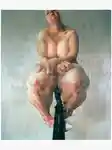
Jenny Saville, Propped (1992) © Jenny Saville. DACS/Copyright Agency, 2026. Courtesy the artist and Gagosian.
In the early 1990s, a young graduate of the Glasgow School of Art, Jenny Saville, burst onto the scene, with paintings that not only used paint to depict flesh in new, pioneering ways, but challenged the image of the female nude.
While she borrowed styles from, and worked on similar scales to, the Old Masters, Saville’s bodies were unlike anything in art history – especially since women’s bodies had so often been presented by a man.
They were bulbous, uncomfortable and, at times, violent, like Propped: a nude self-portrait of the artist that depicts her sitting on a precarious-looking stool (spikily jamming into her ankle), with a top-heavy body and bird-like feet, and bitten-down nails that violently claw into her skin.
Jenny Saville, Propped (1992) © Jenny Saville. DACS/Copyright Agency, 2026. Courtesy the artist and Gagosian.
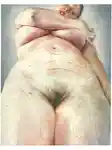
Jenny Saville, Plan (1993) © Jenny Saville. DACS/Copyright Agency, 2026. Courtesy the artist and Gagosian.
Speaking about Propped, she told me: “I got the idea from looking at a budgie in a cage. And this idea that you're put on display to be beautiful, but at the same time you're restricted because that's the way you have to behave to be a good female.”
What does it mean to be put on display? How must a woman be, act, and look like? Should she look like this, or should she succumb to something else?
A year later, in 1993, Saville observed women who were planning liposuction, as seen in her painting, Plan, of a nude body with contour lines that show where the surgery will take place.
Jenny Saville, Plan (1993) © Jenny Saville. DACS/Copyright Agency, 2026. Courtesy the artist and Gagosian.
Speaking about Propped, she told me: “I got the idea from looking at a budgie in a cage. And this idea that you're put on display to be beautiful, but at the same time you're restricted because that's the way you have to behave to be a good female.”
What does it mean to be put on display? How must a woman be, act, and look like? Should she look like this, or should she succumb to something else?
A year later, in 1993, Saville observed women who were planning liposuction, as seen in her painting, Plan, of a nude body with contour lines that show where the surgery will take place.
What I find extraordinary is how beautiful Saville’s works are, despite them presenting bodies that are not included in what is deemed as ‘beautiful’ by society’s – and art history’s – standards.
By pushing paint to its very limits through the multitudes of textures used in just one painting, she shows us the beauty of what lies on the body, in its real and raw state. Saville’s women claim control from a male-dominated world.